How do I develop a comprehensive potent compound safety program?
Here at Affygility Solutions we often get asked, "How do a I develop a comprehensive potent compound safety program? Well, the secret to developing a comprehensive program is no different than establishing any other management system program, whether it be for quality, occupational safety, or for environmental performance. For the purpose of this article, we will follow the risk management decision making framework (hereafter, known as the "framework") used by the American Industrial Hygiene Association (AIHA). This framework is show in the following graphic:
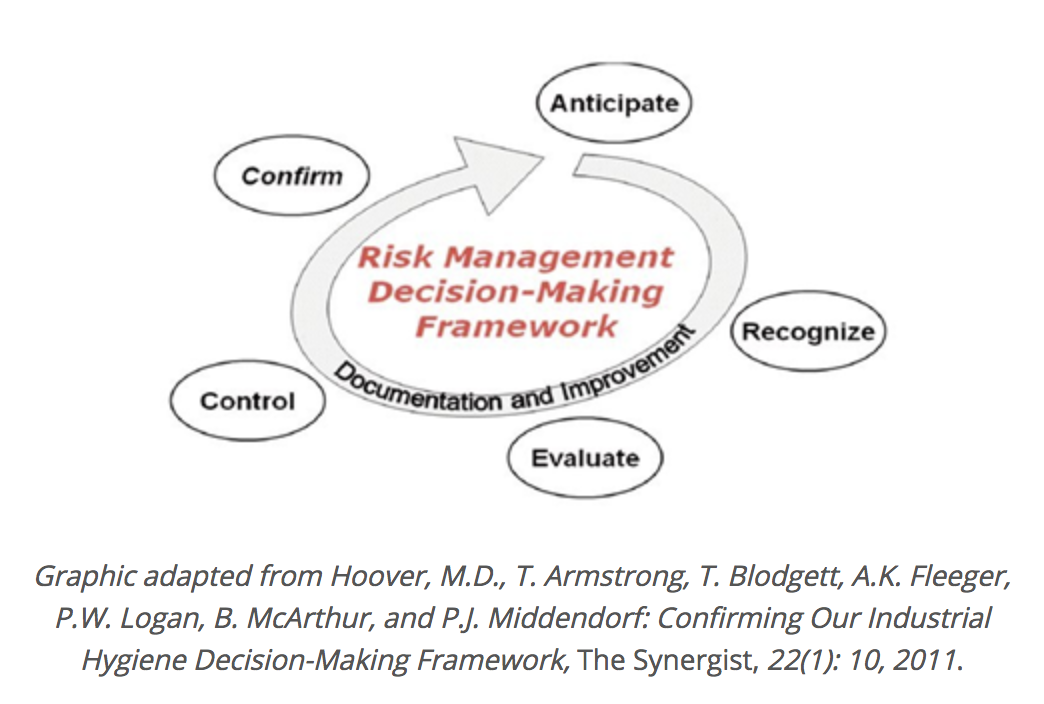
Listed below we will discuss each of the major stages of the framework.
Anticipate
Anticipation is best done at the design stage of a process or new facility, or if there is significant modifications being done to an existing facility or process. The anticipation stage is also relevant when you are just starting your PCS program. At this stage, key steps may include:
- The first step in establishing your PCS program is to assemble your team. An effective PCS program must have involvement from all the major stakeholders such as sales, facilities and maintenance, research, pre-clinical and clinical development, manufacturing, quality, training and development, and EH&S. Trying to develop and implement a PCS program without all the major stakeholders involved is setting up the program for failure.
- Develop a written potent compound safety policy that requires the pre-assessment of the risk of handling a specific compound. Include a commitment to ensure that budgets for PCS are defined, that employees are trained, procedures are developed and implemented. Include a requirement for a periodic review of the PCS program to ensure that all elements of the program are effective. This policy should be endorsed by the most senior level person at the facility. Once the policy is finalized, all employees, including business development staff at CDMOs, should be trained on the policy.
- Established processes where PCS requirements are evaluated during the design or modification of facilities and/or processing suites. This is otherwise known as a "PCS facility design review." Please note, that while architects may understand fire and building code requirements, it is quite rare that they understand PCS requirements that come from years of pharma-industry experience. It's sometimes helpful to develop a design-review checklist to make sure nothing gets forgotten.
- Develop a comprehensive "on-boarding questionnaire" that asks relevant toxicological and hazard questions about the specific compound and process. Ensure that the completed on-boarding questionnaires evaluated by competent personnel that are trained in toxicology and/or industrial hygiene. Please note: Just obtaining a safety data sheet is rarely adequate. Most safety data sheets are poorly written and do not contain enough information to make handling decisions.
- At this stage it may be helpful to have a complete inventory of all the possible compounds that you will be handling. Assigned an occupational exposure band (OEB), sometimes called OHC (occupational hazard categorization) to each of the specific compounds prior to use or a numerical occupational exposure limit (OEL) . This will require that the company either adopt an existing or develop a company-specific OEB scheme. The potent compound safety experts can assist you in developing a OEB scheme for your company. Ensure that the company has ADE or PDE values for each of those compounds. In addition, if the compounds that your company handles are typically generic compounds then fully-documented monographs may already exist in our online catalog of OEL Fastrac monographs.
- While not an absolute requirement, at this point you may want to create a high-level "potent compound safety program" document that provides definitions and assigns responsibilities for each of the program elements. It should refer to each of the individual elements which are likely separate procedures or documents.
Recognize
The recognition stage of the PCS framework is done to detect existing hazards that may have gone previously undetected. The recognition stage may involve a formal observation of each step in the process to look for potential exposure issues (i.e visible dusts, powder, open transfers of powder, or high-energy processes with inadequate containment) or for areas where improvements can be made. It should be noted, that at this stage, it is not a detailed qualitative risk assessment. You are only making a priority list for the risk assessments. The recognition stage also involves recording and acting upon any allegations of adverse health effectives from exposures to APIs.
Evaluate
The evaluation stage is where you perform qualitative risk assessments to determine priority operations and activities for industrial hygiene monitoring. Keep in mind that, in general, no company has enough time, resources, and equipment to perform industrial hygiene monitoring of every activity. Therefore, the use of a structure qualitative risk assessment is useful in prioritizing those activities that require either surrogate monitoring or compound-specific monitoring. Ideally, you will want to perform compound-specific industrial hygiene monitoring to obtain the most accurate results. However, compound-specific methods may not exist for every compound or may be cost-prohibited for early stage compounds. IH monitoring should be performed by qualified personnel that have industrial hygiene training and pharmaceutical industry experience. The potent compound safety experts at Affygility Solutions can assist you in either surrogate monitoring or industrial hygiene monitoring.
Control
Once either surrogate or compound-specific industrial hygiene monitoring has been performed, additional controls may need to be installed and implemented. In general, you will be looking for controls that are effective at reducing exposures to approximately 1/10th of the lowest OEL for the compounds that you will be handling. Controls should be considered in the following order:
- Engineering controls such as isolators, flexible containment, powders weighing hoods, or high-containment transfer values should always be considered first. Using engineering controls greatly reduces the chance for human error and provides more consistent results. In addition, engineering controls reduce the probability of cross-product contamination (something that PPE alone will not provide).
- Administrative controls such as cleaning procedures, emergency procedures, training, job rotation, medical surveillance, waste disposal of APIs, and other procedures should be considered after all engineering controls have been implemented to the greatest degree possible.
- Personal protective equipment such as gowning, respiratory protective, and gloves should be the last resort and for controlling exposures. The use of personal protective equipment as the primary means of exposure control is not acceptable. You will want to make sure that you have documented procedures and training programs on gowning and degowning, and respiratory protection.
Confirm
The confirmation stage involves auditing your previous efforts to make sure that they are consistently being performed and documented. Once an audit has been completed, a system for entering "corrective and preventative actions (CAPAs) should be implemented to ensure that no findings go uncorrected.
Summary
In summary, developing and implementing an effective PCS program is no different than establishing any other program: 1) form your team; 2) write your policy, manual and procedures; 3) train your employees; 4) audit your results; and 5) correct your shortcomings.