How do I apply ADE or PDE values?
One of the most common mistakes that regulatory agencies observe is that companies obtain ADEs (synonymous with PDE) then only use it for establishing cleaning limits. As can be see in the graphic below, the Quality Management System for managing the risk of cross-contamination involves many more elements than just cleaning validation and setting limits.
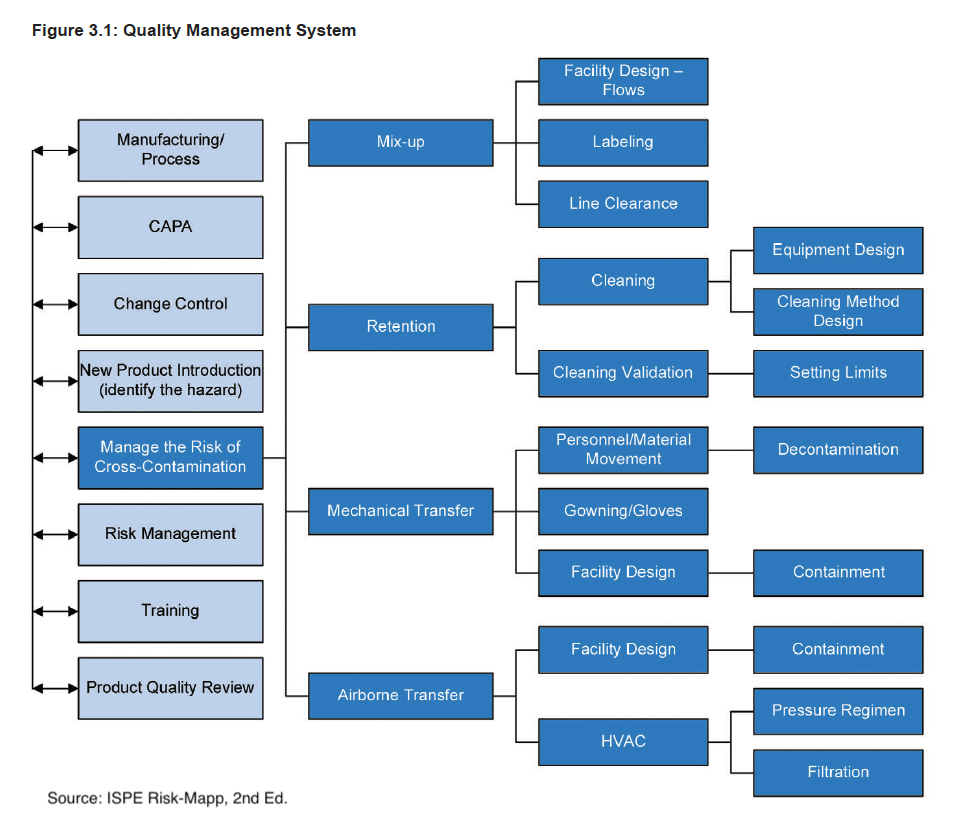
Once an ADE value or estimated ADE value is obtain then a "risk assessment" should be performed. Remember the following concept:
Risk = Hazard X Probability of Exposure
where,
Risk = a relative priority number. This number has no units associated with it and can only be used in the context of all other cross-contamination risks.
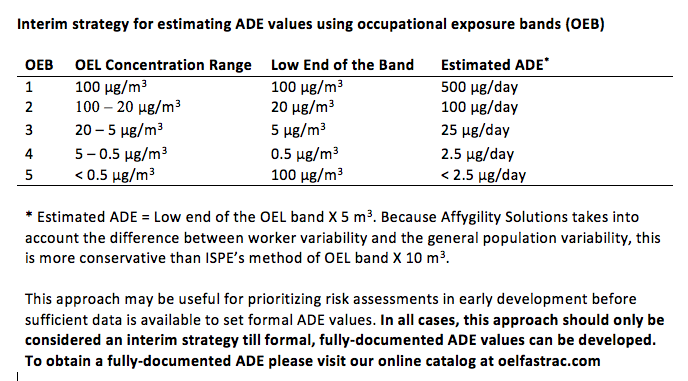
Hazard = is a relative hazard rating based solely on the toxicology of the compound. Most companies just used the OHC or OEB assignment for this ranking. For example an OEB 2 compound would have a hazard ranking of 2, and an OEB 5 compound would have a hazard ranking of 5. The relative hazard rating and ADE can be estimated from using the OEB chart below (note: this is the 5-band Affygility Solutions' banding system so you would have to modify it to fit your company's specific system). It's important to note, this is only an interim strategy solely for performing the risk assessment until a formal OEL/ADE monograph can be authored.
Probability of Exposure = is how likely is a negative event going to occur. This is where it gets more complicated since they are many factors that can cause a negative events. These factors include the ability to detect a failure, what current controls are in place, ease of cleanability, what is the frequency of past negative events, etc.
In general, what companies do is create a risk assessment spreadsheet or other tool (we use Affytrac's Risk Assessment Online Tool) to list all the process steps, a hazard rating for each compound, the rating for the frequency of past occurrences, and a rating for the ease of detection. The ratings are then multiplied all together and you come up with a risk priority number (RPN). Base on the RPN, you make risk management decisions and determine the necessary corrective actions (which could mean additional controls, performing surrogate monitoring, procedures, etc.). These decision could include those shown in the graphic below.
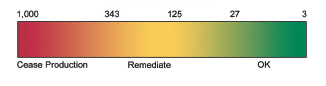
To develop your own decision scale like about, simply take the worst case of all compounds and the worst case ratings for each factor, then multiply them together to determine the upper limit for the RPN ranking. Do the same for the lowest case compounds and rating factors to determine the lower limit. Then divide your scale up into four segments. The upper 25% of the RPN would require immediate action and the lower 25% generally require no further action. Your cross-contamination risk management goal is to get all process steps down to the lower 25%.
It's important to remember that RPN numbers are unit-less and relative to all the other RPNs. It is only to establish a priority for corrective action and process improvement. The numbers on your company's scale may vary quite differently and the number itself doesn't matter as long as you use the risk assessment consistently across all processes.
Summary
In summary, the QMS for managing the risk of cross-product contamination is all about understanding the hazards of ALL of your active pharmaceutical ingredients (APIs), developing a risk-assessment methodology, consistently applying the risk-assessment methodology across all of your processes, then making risk management decisions and performing corrective actions where necessary.
For much more detail on conducting risk assessments, I suggest you purchase ISPE Baseline® Guide: Risk-Based Manufacture of Pharmaceutical Products.
If you need an ADE monograph please visit our OEL Fastrac online catalog.
|
|
|